
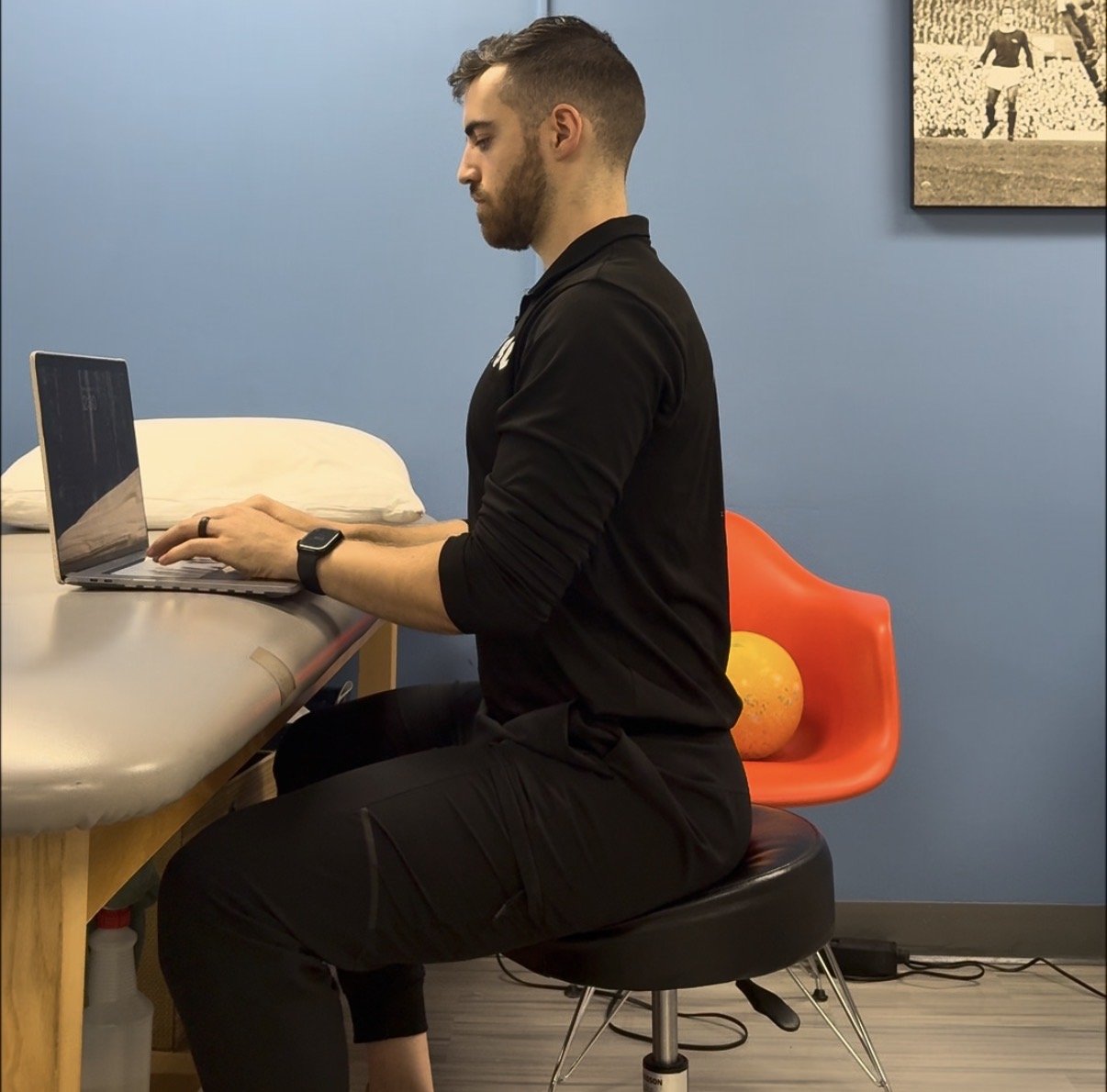
If your lower back aches by 3 p.m. and screams by the end of the day, you've probably been told to "sit up straight." Here's the problem: that advice is mostly wrong. Sitting isn't the villain. Staying still is.
As a doctor of physical therapy, this is one of the most common complaints I hear from busy professionals. The good news is that the fix doesn't take hours at the gym. It takes a different way of thinking about how you sit, how you train, and how you set up your day.
The real problem: hours in one unsupported position
Most desk workers spend the bulk of the workday seated, often in long, unbroken stretches. Hold any position for 8+ hours, especially one where your back isn't supported, and the same tissues take the same load all day long with no break. Muscles fatigue, joints stiffen, and your back starts sending you signals.
And it isn't just sitting. In lab studies of healthy people, clinically relevant low back pain showed up after about 71 minutes of uninterrupted standing on average, and after only about 42 minutes in people prone to it. That doesn't mean you can never stand longer. Some jobs and days don't allow it, but whenever possible in your workflow, avoid standing for more than about 40 minutes at a time. [1] Swap your chair for a standing desk and stand like a statue all day, and you've just traded one static position for another.
The research backs this up. A 2025 review of 22 studies on office workers found that sitting behavior (how often you take breaks and how static you are) had the strongest link to low back pain, stronger than total sitting time or the "quality" of your posture. [2]
Why "perfect posture" is a myth
A review of 41 systematic reviews found no consensus that any particular spinal posture, including sitting, actually causes low back pain. [3] People with "bad" posture often have no pain, and people with "perfect" posture often do.
That leads to the most useful rule I give every client:
The best position is your next position.
Yes, I know it sounds corny. It's also true. Slouch for a while. Sit tall for a while. Lean back. Stand. Perch on the edge of your seat. No single position is the "right" one. The problem is any position you hold too long.
Train your core like it has a job to do
Exercise is one of the best-supported treatments for chronic low back pain. A Cochrane review of 249 trials found that exercise reduced pain more than no treatment, by an amount large enough to matter. [4] But "do some crunches" isn't a plan. Here's how I program the core for desk workers.
1. Build stability in all three planes of movement
Your spine moves and resists force in three directions, so your core needs to control all three:
- Sagittal plane (front to back): resisting your spine from arching or rounding. Think front planks, dead bugs, and bird dogs.
- Frontal (coronal) plane (side to side): resisting side bending. Think side planks and suitcase carries, where you walk holding a weight in one hand.
- Transverse plane (rotation): resisting and controlling twisting. Think Pallof presses and anti-rotation holds with a band or cable.
Most people only train the first one. A core that is only stable front to back is like a table with one sturdy leg.
2. Teach your core to tolerate heavier loads
Your back is built to handle load. Too often, people with back pain get told to avoid lifting, which makes the back less prepared for everyday life. Strength training gradually teaches your trunk to handle more.
In one randomized trial, people with mechanical low back pain who did a high-load lifting program built around the deadlift improved just as much as those doing gentle motor-control exercises, with 50–80% reporting less pain and disability up to two years later. [5] A network meta-analysis of 89 trials found that resistance training ranked among the most effective exercise types for improving physical function in chronic low back pain. [6]
The key is progression: start with weights you can control with good form, then build up over weeks, not days.
Not sure how to lift safely, or have an injury you need to work around? Book a free consultation. I'm a doctor of physical therapy, and building strength around pain and injuries is my bread and butter.
3. Don't skip general mobility
A strong core that can only move through a tiny range is still a limited core. General mobility work keeps your hips, mid-back, and spine comfortable moving through their full range, so no one area does all the work.
One note: the research favors active mobility, meaning controlled movement through your full range like Pilates-style work, hip openers, and thoracic rotations. In the same network meta-analysis, Pilates ranked highest for reducing pain, while static stretching on its own didn't beat no exercise at all. [6] So move through your range; don't just hang out in a stretch.
Set up your desk for the positions you actually use
Ergonomics won't fix a back that never moves, but a good setup makes each position easier to hold while you're in it. Remember, the goal is still to change positions often. Here's a quick checklist based on OSHA's computer workstation guidelines: [7]
When you sit
- Back: use your chair's lumbar support, or a small pillow or rolled towel, so your lower back is supported instead of hanging unsupported.
- Feet: flat on the floor or a footrest, with knees roughly level with your hips.
- Arms: elbows close to your sides at roughly 90 degrees, with wrists straight while typing.
- Screen: directly in front of you, about an arm's length away (20–40 inches), with the top of the screen at or slightly below eye level.
When you stand
- Set the desk so your elbows stay near 90 degrees while typing.
- Use a small footrest or rail and alternate resting one foot on it. That shifts the load on your lower back.
- Wear supportive shoes, or use an anti-fatigue mat on hard floors.
On a laptop
- Raise the laptop so the top of the screen is near eye level (a stand or a stack of books works), then use a separate keyboard and mouse. A laptop on its own forces you to choose between a good screen height and a good typing position.
The habit that ties it together: a movement alarm
Knowing you should move is easy. Remembering to actually do it during a busy workday is the hard part. Here's the simplest fix I know:
Set an alarm for every 30 minutes or so. When it goes off, change your position. Stand up, sit differently, walk to refill your water, do a few hip circles. It only takes 30 seconds.
This works. In a 6-month randomized trial of office workers at high risk of back pain, those prompted to take active breaks or shift their posture during the day had far fewer new cases of low back pain: 7–9% versus 33% in the control group. [8] An earlier systematic review found that active breaks with a change in posture were the type of break with the most consistent benefit, and they didn't reduce productivity. [9]
The caveat: only use the alarm for a few days to a week. The alarm is training wheels. The goal is for your body to start noticing stiffness and shifting on its own, without a phone telling it to. If you catch yourself frozen in one position for hours again a few weeks later, run the alarm for another week to reset the habit.
The bottom line
- It's not sitting, it's staying still. Avoid holding any one position for hours.
- The best position is your next position.
- Train your core for stability in all three planes, build up to heavier loads, and keep your mobility.
- Set up your desk so each position is easier to hold, then keep changing positions anyway.
- Use a 30-minute movement alarm for a week to build the habit, then let your body take over.
If you've tried all this and your back still isn't improving, or you want a plan built around your specific body and schedule, book a free consultation. As a doctor of physical therapy, I build programs that work around your pain instead of ignoring it. Want this for your whole team? See Workplace Performance.
This article is for education and is not medical advice. See a doctor promptly if your back pain comes with numbness or tingling in the groin area, new bladder or bowel problems, leg weakness, fever, unexplained weight loss, or pain after a fall or injury.
References
- Coenen P, et al. Associations of prolonged standing with musculoskeletal symptoms: a systematic review of laboratory studies. Gait & Posture. 2017;58:310–318. doi:10.1016/j.gaitpost.2017.08.024
- Low back pain and sitting time, posture and behavior in office workers: a scoping review. J Back Musculoskelet Rehabil. 2025;38(5):919–943. doi:10.1177/10538127251320320
- Swain CTV, et al. No consensus on causality of spine postures or physical exposure and low back pain: a systematic review of systematic reviews. J Biomech. 2020;102:109312. doi:10.1016/j.jbiomech.2019.08.006
- Hayden JA, et al. Exercise therapy for chronic low back pain. Cochrane Database Syst Rev. 2021;9:CD009790. doi:10.1002/14651858.CD009790.pub2
- Michaelson P, et al. High load lifting exercise and low load motor control exercises as interventions for patients with mechanical low back pain: a randomized controlled trial with 24-month follow-up. J Rehabil Med. 2016;48(5). doi:10.2340/16501977-2091
- Owen PJ, et al. Which specific modes of exercise training are most effective for treating low back pain? Network meta-analysis. Br J Sports Med. 2020;54(21):1279–1287. doi:10.1136/bjsports-2019-100886
- OSHA. Computer Workstations eTool: Monitors. osha.gov
- Waongenngarm P, et al. Effects of an active break and postural shift intervention on preventing neck and low-back pain among high-risk office workers: a 3-arm cluster-randomized controlled trial. Scand J Work Environ Health. 2021;47(4):306–317. doi:10.5271/sjweh.3949
- Waongenngarm P, Areerak K, Janwantanakul P. The effects of breaks on low back pain, discomfort, and work productivity in office workers: a systematic review. Appl Ergon. 2018;68:230–239. PubMed 29409639